Beyond the Click
Practical tips, trends, and insights to grow your business in an evolving online world
Local Visibility Is More Than Ranking #1:
How Small Businesses Can Get Found, Understood, and Chosen

At seven in the morning, a homeowner in Weaverville discovers the heat is not working and reaches for their phone. On a Friday afternoon, a family visiting Brevard needs somewhere that can seat a group of twelve. On a Tuesday night, someone in Arden types a question about retirement planning into a search box.
None of those people are looking for a marketing strategy. They are looking for a business that can help them, near them, now.
For years, small business owners were told that winning local search came down to one thing: rank number one for a single valuable keyword. That advice was always incomplete, and today it describes only a narrow slice of how customers actually find and choose local businesses.
The more useful question is this:
That question covers far more ground than a ranking report. It reaches into your Google Business Profile, your website, your reviews, your business listings, the way you describe your services, and the places customers now look before they ever click through to you.
This article explains how local visibility actually works today, what current consumer research says about the way people choose local businesses, and how Skyland Digital’s Visible Growth System™ manages those connected pieces for the businesses we work with.
We manage your online presence so you don’t have to.
What Local Visibility Actually Means
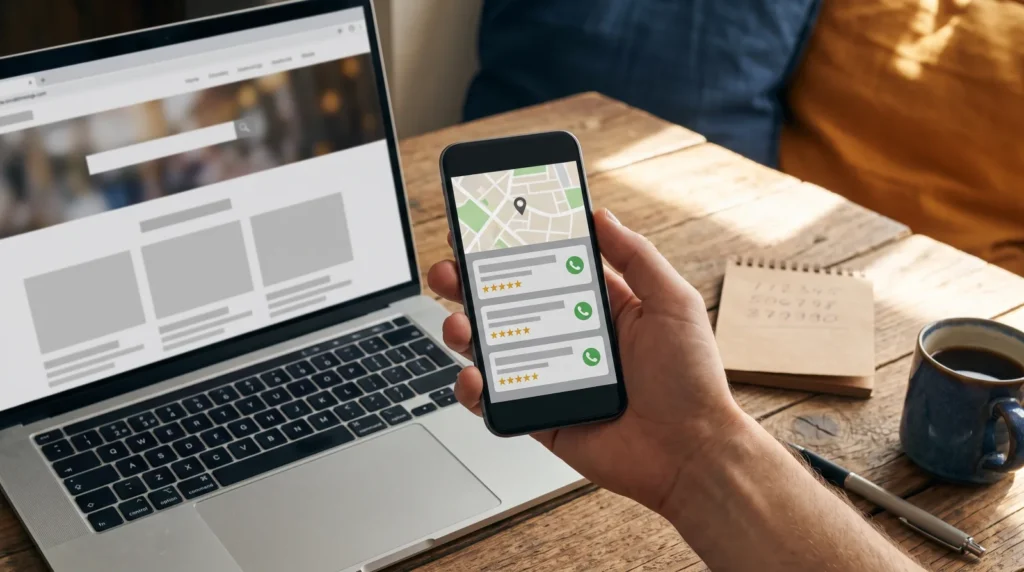
Local visibility is the sum of every place a nearby customer might encounter your business online, and how clearly each of those places explains what you do.
In practice, that includes:
- Search results, where someone types a problem or a service and a place
- Maps, where they look for something close to them
- Your Google Business Profile, the free business listing that appears in Google Search and Google Maps
- Your website, especially the pages that describe individual services
- Local business listings and directories that repeat your details elsewhere
- Reviews, and the way you respond to them
- Social profiles that confirm the business is real and active
- AI-assisted answers that summarize options before a person clicks anything
Very few customers travel through all of these in a straight line, and almost none of them use only one.
That is the practical case against thinking of local visibility as a single ranking. A customer might notice you in a map result, read two reviews, glance at your photos, open your services page, and then call the number from your profile rather than from your website. Every one of those steps is a place where the business is either easy to understand or slightly confusing.
How People Really Search
for Local Businesses Now

The clearest way to see how much local search has changed is to look at what people actually type. These are not keywords chosen by a marketer. They are the shape of a real problem.
Heating and air conditioning. Someone searches “AC repair near me” when the house is already too warm. Someone else searches “heat pump not heating” because they are trying to understand the problem before they call anyone. A third searches “emergency HVAC repair Asheville” at ten at night. Those are three different people at three different stages, and one ranking does not serve all three.
Remodeling and contracting. “Kitchen remodel contractor near me” is usually someone ready to start collecting quotes. “Bathroom renovation Asheville” may be someone still deciding whether the project is realistic at all. Both are worth being visible for, and each needs different information on arrival.
Real estate. “Homes for sale in Weaverville” and “new construction homes Asheville” are searches about a place, not about an agent. The businesses that appear for them are the ones that have made their local knowledge findable.
Restaurants. “Restaurant catering in Brevard” and “restaurant for a group” describe an occasion. The person is not browsing menus for enjoyment. They have a date, a headcount, and a decision to make.
Financial services. “Financial adviser near me” is broad. “Retirement planning Asheville” is specific. The second search is smaller and often far more valuable, and it is frequently the one nobody has thought about.
Read those together and a pattern appears. Customers search by problem, by service, by occasion, and by place. A business that is visible only for its broadest category term is missing most of the conversation.
Why Ranking #1 for One Keyword
Is the Wrong Goal
Rankings still matter. Appearing high in results for a broad, high-volume term can be genuinely valuable, and nothing here suggests otherwise. The problem is treating that single position as the finish line.
Two things are true at once. Position influences whether you are seen. It does not decide whether you are chosen.
Those numbers describe a person comparing, not obeying. And they are comparing quickly. In the same study, 72% of consumers looked at three or fewer businesses before deciding, and 75% reached that decision in under thirty minutes.
That combination is the real lesson. You have a short window, you are being compared against two or three alternatives, and most of what is being compared is information you control: your location and service area, your rating, your review count, how complete your listing is, whether your pricing is clear, and whether your photos look like a real business.
Most Local Searches
Come With a Decision Attached
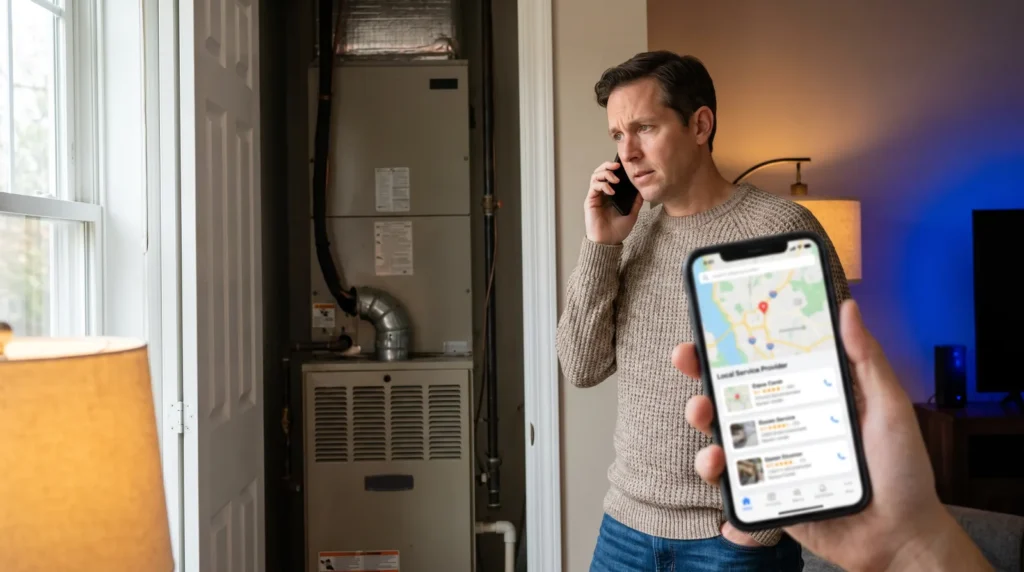
There is a meaningful difference between someone researching a topic and someone with a need, a service, and a location already in mind.
“How does a heat pump work” is research. “Emergency HVAC repair Asheville” is a person with a cold house and a phone in their hand. The second search is smaller in volume and far closer to a decision.
Local searches skew heavily toward the second kind, which is why local visibility connects so directly to the things a business actually counts:
- Phone calls
- Quote and estimate requests
- Consultations
- Appointments and bookings
- Reservations
- Visits to the store or office
- Purchases
It is worth being careful here. Visibility does not convert on its own, and no honest marketing partner can promise a specific number of calls from a specific ranking. What visibility does is put your business in front of people at the moment they are deciding. What happens next depends on whether your information is complete, your reviews are reassuring, and your next step is obvious.
How Google Decides
Which Local Businesses to Show

Google explains its local results using three ideas. They are worth understanding in plain English, because they shape almost everything else in this article.
Relevance is how well your business matches what someone searched for. Google’s own guidance is that complete and detailed business information helps it match you to the right searches. If you install and service tankless water heaters but never say so anywhere, you are asking Google to guess.
Distance is how far your business is from the person searching, or from the area they named. If someone does not share their location, Google works from what it can reasonably infer.
Prominence is how well known a business is. Google attributes this partly to what it can learn about the business from across the web, including links to your site and your reviews.
You cannot change distance. You can meaningfully influence relevance and prominence, and that is where nearly all of the practical work sits.
Your Google Business Profile is the free listing that represents your business inside Google Search and Google Maps. If you have never claimed one, there may already be a version of it. It carries the details a customer checks immediately before contacting you:
- Business name and category
- Opening hours, including holiday hours
- Phone number
- Link to your website
- The specific services you offer
- Photos of the business, the team, and the work
- Reviews, and your replies to them
- Directions to you, when customers come to you
Google is direct about two things worth repeating. Businesses with complete and accurate information are more likely to appear in local results. And there is no way to request or pay for a better local ranking.
A claimed profile also reports how people are finding and using it. Google’s performance metrics cover searches, views, calls, direction requests, website clicks, messages, and bookings. That is one of the more honest views a local business has of its own demand, though it is worth knowing the data reflects both organic results and Google Ads.
Keeping all of that current is ongoing work rather than a one-time setup, which is why we offer it as Google Business Profile management.
Service-Area Businesses
Need a Different Approach
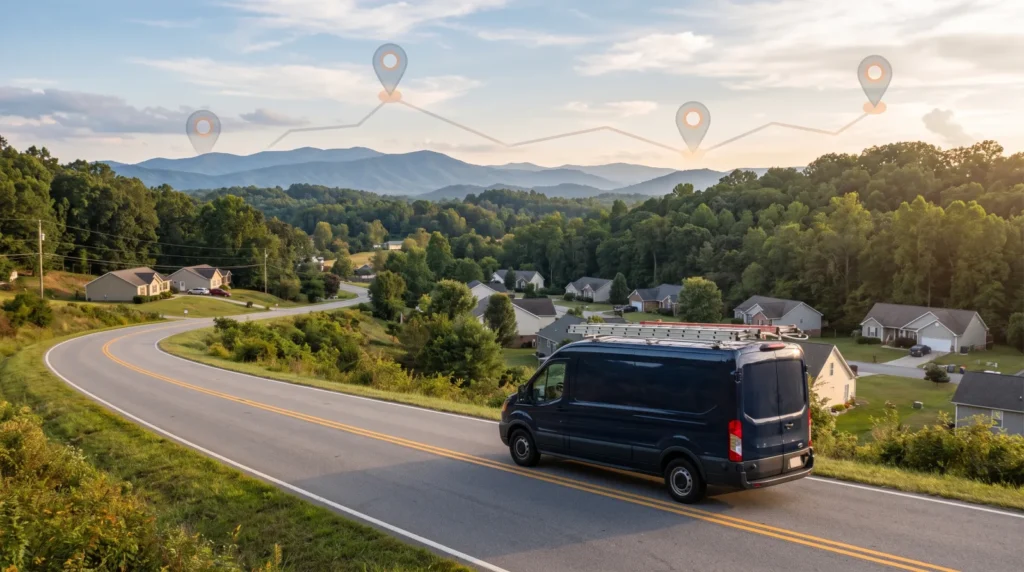
A service-area business travels to its customers instead of serving them at its own address. If your customers do not come to you, you are one:
- Heating and air conditioning companies
- Plumbers and electricians
- Remodeling and general contractors
- Landscaping and lawn care
- Cleaning services
- Mobile and on-site services of almost any kind
Google has specific rules for these businesses, and they are frequently misunderstood.
- You should have one profile for the business, with a service area attached to it. Not one profile for every town you serve.
- If customers never visit your address, that address should be hidden on the profile. This matters for anyone running the business from home.
- Service areas are defined by real places such as cities or postal codes. They are not drawn as a radius around a pin.
- A profile can list up to 20 service areas, and Google suggests the overall area should not extend much beyond about two hours of driving from where the business is based.
- Any address you do display has to be a real, staffed location. P.O. boxes and unstaffed virtual offices are not eligible.
The temptation for service businesses is to invent presence, creating addresses in nearby towns in order to look local everywhere at once. Beyond breaking Google’s guidelines and putting the profile at risk, it does not survive contact with a customer who calls the number and reaches someone forty minutes away.
The better approach is to represent the footprint you genuinely serve, then make that footprint legible everywhere else: on your website, across your service pages, and in the way you describe the communities you actually cover.
Your Website Still Does Real Work
A Google Business Profile is not a substitute for a website. The two support each other, and each does something the other cannot.
Service pages. One page for each meaningful service, written for a person who is deciding, is the most useful structural thing missing from most local websites. A single page listing nine services in a bulleted row gives a customer almost nothing to read and gives search engines almost nothing to match.
Location relevance. The towns and neighborhoods you serve should appear naturally in the places it makes sense: the areas you cover, the projects you have completed, the way you describe your work. This is not about repeating a city name until it stops sounding like English.
Customer questions. The questions people ask before they buy are the questions they are also typing into search. Answering them in public is useful to the customer and useful to your visibility at the same time.
Contact information. Consistent, current, and easy to find on every page, with a tappable phone number.
Conversion pages. The pages where an enquiry actually happens deserve as much attention as the pages that attract traffic. Visibility that arrives at a confusing contact form has been wasted.
Structured data. LocalBusiness structured data is a small block of code that labels your business details so search engines can read them without having to interpret your page design. Google’s documentation requires only two properties, a name and an address, and recommends others such as telephone number, geographic coordinates, price range, and a link to your site.
Two caveats matter here, because this is an area where marketing claims tend to outrun the documentation. Google states plainly that it does not guarantee that features using structured data will appear in search results, so schema is not a ranking tactic. And LocalBusiness markup has no property for declaring a service area, so it does not replace setting your service areas properly on your Business Profile.
Work of this kind sits inside our website management and search engine optimization services.
Reviews Are Where
Customers Make Up Their Minds

Reviews are not a trick for influencing an algorithm. They are the part of your online presence written by other people, which is precisely why customers trust them.
What customers are actually reading for is more specific than a star average.
Detail. A review that names the job, the timeframe, and what the crew was like does more work than five stars on their own. Reviews that describe a specific service also help future customers recognize themselves.
Quantity. A handful of reviews reads as a small sample. A steady body of them reads as an established business.
Recency. With nearly three quarters of consumers looking for reviews from the last three months, a strong rating earned three years ago answers a different question than one earned last month.
Responses. Google’s guidance is that responding to reviews shows customers you value their feedback. A calm, specific reply to a critical review is often more persuasive to the next reader than the complaint itself.
Photos. Customer photos, and your own, tell people what to expect before they arrive.
Consistency. One poor review among many good ones is normal, and frequently reassuring. A pattern of the same complaint is a business problem rather than a marketing one, and it is better to know.
Google’s current wording on ranking is measured, and worth representing accurately: more reviews and positive ratings can help a business’s local ranking. That is not a guarantee, and treating reviews purely as a lever tends to produce exactly the kind of review activity customers learn to see through.
Your Listings Should All Tell the Same Story
Beyond Google, your business details appear in a surprising number of other places: directories, apps, mapping services, industry listings, and the data providers that quietly feed all of them.
The details that need to agree everywhere are simple enough to list:
- Your business name, as customers actually know it
- Your address, if you have a public one
- Your phone number
- Your website
- Your hours, including holiday hours
- The services you offer
The problem with inconsistency is rarely algorithmic. It is human. An old phone number sends a ready customer to a dead line. Outdated hours send someone to a closed door on a Sunday. A former address sends a first-time visitor to the wrong building. Each of those is a customer you had already won, lost at the very last step.
This is ordinary maintenance, and it is exactly the kind of work that slips when the business gets busy. We handle it as business listings management.
Local Visibility Now Spans More Than One Screen
The last significant shift is simply where all of this happens.
Mobile is not a segment of local search. It is the default. That has direct consequences: pages need to load quickly on a phone using mobile data, phone numbers should be tappable, and the information a customer needs first belongs near the top rather than three scrolls down.
Alongside that, AI-assisted search has become part of the picture. Search engines increasingly summarize answers directly, and some people now begin with an AI assistant rather than a search box.
It would be wrong to claim that AI has replaced Google. The research does not support it, and Google Search remains where the largest share of local searches begin. What has changed is that a summary may now sit between the customer and your listing. Those summaries are assembled from the same underlying material: your profile, your website, your reviews, and what other sources say about you. A business whose information is accurate, complete, and consistent gives every one of these systems the same clear answer to work from.
The practical takeaway is unchanged, and it runs through this entire article. Customers move between channels, so the story your business tells has to hold together across all of them.
Why Local Visibility
Breaks Down for Small Businesses

We rarely meet an owner who does not already know this matters.
What we see instead is a list of tasks that are each individually manageable and collectively another job:
- The website needs updating whenever services, pricing, or staff change
- The Business Profile needs hours, photos, services, and posts kept current
- New reviews need responses, and not three weeks later
- Listings drift out of date and need correcting
- Service pages and customer questions need writing
- Analytics need reading, and more importantly acting on
- Service information changes and has to be updated in several places at once
- Pages that are not converting need improving
None of that is difficult. All of it is relentless. It competes with payroll, scheduling, hiring, quality control, and the customer standing in front of you right now, and it loses that competition almost every week, because nothing visibly breaks on the day you skip it.
That is the real failure mode of local visibility for small businesses. Not ignorance, and not a lack of effort. It is that consistency is genuinely hard to sustain while running the business the marketing is meant to support.
The Visible Growth System™ Turns
Local Visibility Into an Ongoing Process

The Visible Growth System™ is how Skyland Digital manages the connected parts of a local online presence as one coordinated process rather than a collection of separate projects.
It is not software you log into and operate yourself. It is a managed service, led by people, supported by technology and AI where those genuinely help. The value is in the ongoing execution, the coordination between the pieces, and being accountable for both.
What we coordinate:
Google Business Profile management. Categories, services, hours, photos, attributes, and posts kept accurate and current, with the profile treated as a live storefront rather than a form filled in once.
Local search optimization. Building visibility across the services, questions, problems, and places that connect you with nearby customers, instead of chasing a single broad term.
Website management. Service pages, location relevance, customer questions, technical health, and the pages where enquiries actually happen.
Business listings. Keeping your details consistent across the directories and data sources that repeat them.
Reviews and reputation. Encouraging a steady flow of genuine reviews, and responding in a way that reads well to the next customer.
Service content and customer questions. Answering, in public, the things people ask before they buy.
Analytics and reporting. Watching what is actually happening across search, profile, and website, and translating it into plain language.
Ongoing optimization. Acting on what the data shows, month after month.
The reason these are managed together is that they are not genuinely separate. Your service pages inform what your profile can credibly claim. Your reviews influence whether a strong ranking turns into a phone call. Your listings either reinforce your hours or quietly contradict them. Managed in isolation, each piece can look fine while the overall presence stays inconsistent.
In practice this makes us an extension of your team. You keep the part only you can do, which is knowing your customers and delivering the work. We take the part that keeps slipping. You can see the whole picture on the Visible Growth System™ page, and how it applies more broadly to online marketing for small business.
Local Visibility Should Be Visible
to the Business Owner Too
One of the oldest complaints about marketing services is that the work happens somewhere the client cannot see it. Money leaves the account every month and something, presumably, happens.
We think that is backwards.
At any point, a business owner should be able to answer five questions without having to chase anyone for an update:
- What work was actually completed
- What changed as a result
- What results have been seen
- What opportunities were found along the way
- What happens next
That is the accountability half of the Visible Growth System™. Visibility only the agency can see is not really visibility. Reporting in plain language, a clear record of the work, and a next step you actually agree with are not extras. They are how you judge whether any of this is worth continuing, and that is a judgment you should be properly equipped to make.
Found. Understood. Trusted. Chosen.

It is tempting to reduce all of this to getting found. Being found is only the first of four things that have to go right.
A customer has to find you, among the other options available at that moment.
They have to understand what you do, specifically enough to know you solve their problem, and see that you serve their location.
They have to trust you, which usually comes down to reviews that sound like real people and information that agrees with itself everywhere they look.
And they have to have a reason to choose you, along with an obvious way to take the next step.
Break any one of those links and the others stop mattering. A business nobody can find cannot be chosen. A business that is easy to find but hard to understand gets skipped. A business that is found and understood but looks unverified loses to the one with forty recent reviews. And a business that clears all three, then buries its phone number at the bottom of a page, loses the customer at the final step.
That progression is what the Visible Growth System™ is built around. Not a ranking. A sequence a real customer moves through, managed from one end to the other.
Ready to See How Visible Your Business Really Is?
If your business depends on customers in a specific city, neighborhood, or service area, Skyland Digital can help identify the gaps and opportunities in your local online presence.
The Visible Growth System™ manages the connected pieces that help your business get found, understood, and chosen.
Or explore the Visible Growth System™ to see how the pieces fit together.